
Popeyes Franchise: Cost, Sales, and Diligence (FDD 2026)
A diligence and background report overview of the Popeyes Louisiana Kitchen franchise from the 2026 FDD: investment range, Item 19 sales and EBITDA, unit growth and transfers, the 5% royalty and fee load, the RBI ownership, and the 20-year term and exit terms.
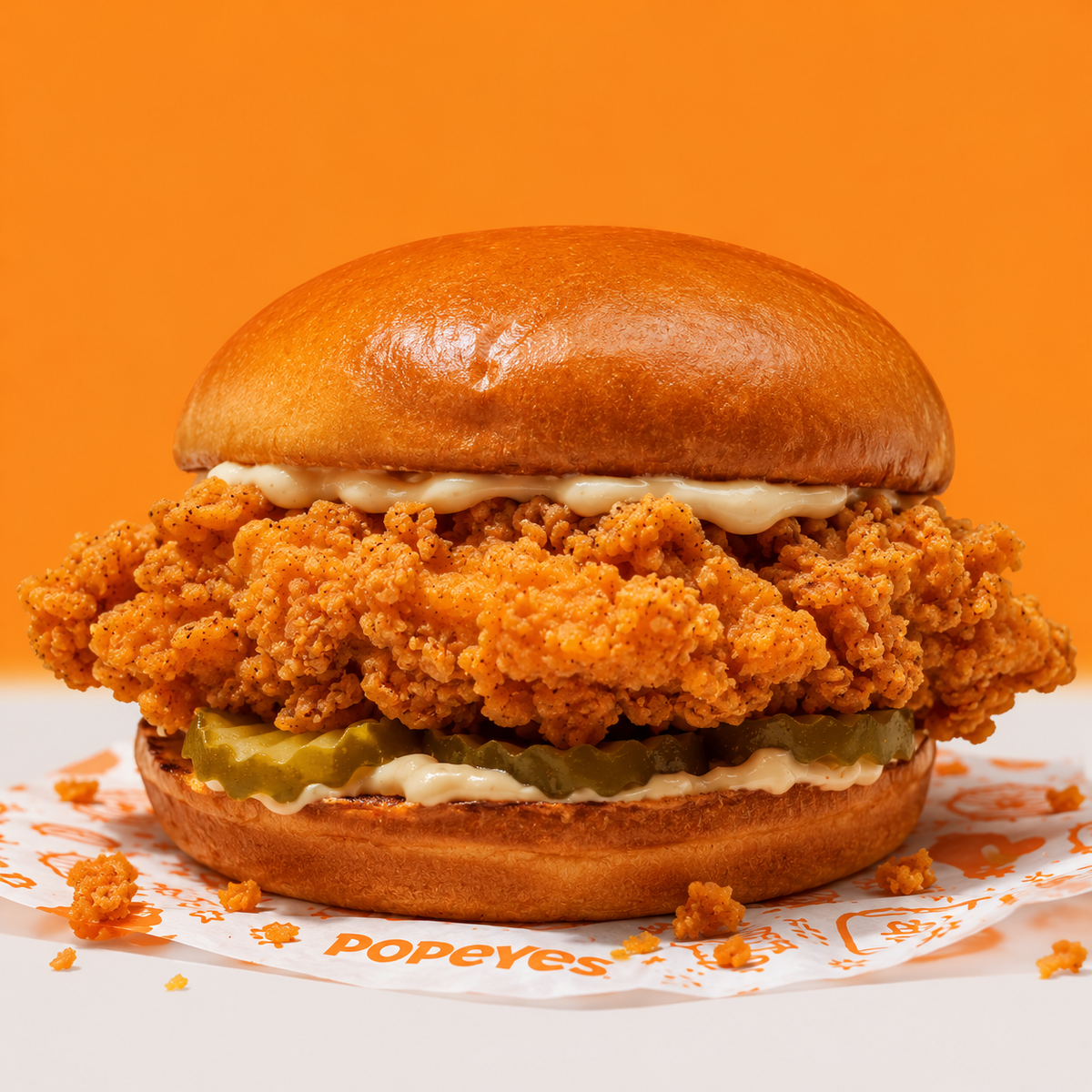
Popeyes Louisiana Kitchen is a quick-service fried chicken franchise based in Miami, Florida, and an indirect subsidiary of Restaurant Brands International (RBI), the company behind Burger King, Tim Hortons, and Firehouse Subs. The 2026 Franchise Disclosure Document (FDD), covering the year ended December 31, 2025, reports 3,134 franchised and 95 company-owned restaurants in the United States, part of 5,413 worldwide. Item 19 reports 2025 average annual sales of $1,893,675 for 2,248 franchised free-standing restaurants.
Popeyes Louisiana Kitchen | Food & Beverage | latest FDD 2026 | 3229 outlets
Reviewer Highlights
About the franchisor
The franchisor is Popeyes Louisiana Kitchen, Inc., formed on July 27, 1992 as America's Favorite Chicken Company, renamed AFC Enterprises, Inc. in 1996 and Popeyes Louisiana Kitchen, Inc. in 2014. It has operated and franchised Popeyes restaurants since November 5, 1992, and its predecessors began selling franchises in 1976, four years after the first Popeyes opened in New Orleans in 1972. In March 2017 Popeyes was acquired by, and is now an indirect subsidiary of, Restaurant Brands International (RBI), whose affiliates also own and franchise Burger King, Tim Hortons, and Firehouse Subs; 3G Restaurant Brands Holdings holds roughly 22% of RBI's voting power. As of December 31, 2025 there were 5,413 Popeyes restaurants worldwide, including 3,228 in the United States and its territories (of which 95 were company-owned) and 2,112 outside the United States.
Leadership sits close to the RBI parent and turned over recently. The Popeyes board includes Jill Granat (RBI's General Counsel), Sami Siddiqui (named director, CFO, and Vice President of Popeyes in March 2024 and also RBI's CFO), and Vicente Tome (a director since June 2025). At the RBI level, Patrick Doyle is Executive Chairman and Joshua Kobza is Chief Executive Officer. Peter Perdue became President, U.S. and Canada in November 2025, Tiffany Ahmed became Popeyes' CFO and Vice President of Finance in September 2025, and Matt Rubin became Chief Marketing Officer in January 2026.
Create an account at Franchise Signal and ask diligence questions within your Claude workspace - all with the added FDD data (across multiple years) for your prospective brand(s). Download FDDs directly for additional research.
Growth and system health
Item 20 shows a system that keeps adding units while churn underneath has picked up. Franchised restaurants grew from 2,593 at the start of 2021 to 2,736 (2021), 2,905 (2022), 3,035 (2023), 3,079 (2024), and 3,134 at year-end 2025. Annual franchised openings were 168, 195, 165, 136, and 104, a slowdown over the last three years, while ceased operations ran 25, 19, 31, 26, and 33 and non-renewals ran 0, 7, 4, 8, and 2. Terminations were 0 from 2021 through 2024 and then 14 in 2025. In 2024 the franchisor reacquired 58 franchised restaurants, lifting company-owned U.S. units from 41 to 98 (95 at year-end 2025). Ownership transfers, where 50% or more of a restaurant changed hands, rose from 128 (2023) and 125 (2024) to 229 in 2025. Looking forward, the 2026 FDD reports 12 agreements signed but not open and projects 104 new franchised restaurants next year, down from the 178 the 2024 FDD had projected.
| Year | Opened | Terminations | Non-renewals | Reacquired | Ceased | Outlets (end) |
|---|---|---|---|---|---|---|
| 2021 | 168 | 0 | 0 | 0 | 25 | 2736 |
| 2022 | 195 | 0 | 7 | 0 | 19 | 2905 |
| 2023 | 165 | 0 | 4 | 0 | 31 | 3035 |
| 2024 | 136 | 0 | 8 | 58 | 26 | 3079 |
| 2025 | 104 | 14 | 2 | 0 | 33 | 3134 |
Item 20 Table 2 reports outlet transfers (50% or more of ownership changing hands) of 128 in 2023, 125 in 2024, and 229 in 2025. The 2025 increase was broad, with notable jumps in California (6 to 26), Arizona (0 to 16), Wisconsin (0 to 11), Alabama (2 to 8), and Colorado (0 to 9).
The U.S. system is overwhelmingly franchised: 3,134 franchised against 95 company-owned at year-end 2025, so company-owned is about 2.9% of U.S. restaurants. That share jumped in 2024 when the franchisor reacquired 58 franchised restaurants (concentrated in Mississippi, Tennessee, and Louisiana), then eased as 3 company units closed in 2025.
As of December 31, 2025, Item 20 Table 5 reports 12 franchise agreements signed but not yet open and projects 104 new franchised restaurants and 0 new company-operated restaurants in the next fiscal year. The 2024 FDD had projected 178 new franchised restaurants, against 104 actually opened in 2025.
What it costs to get in
The 2026 FDD (Item 7) estimates the total initial investment for a free-standing Popeyes at $1,222,045 to $3,923,245, and for a smaller in-line restaurant at $504,545 to $1,968,245; both ranges exclude real estate, which is variable and either leased or bought separately. For a free-standing build the largest lines are the Building at $700,000 to $1,600,000, FF&E, Signage and Technology at $340,000 to $865,000, Site Work at $40,000 to $800,000, and Soft Costs at $10,000 to $420,000, on top of the flat $50,000 Initial Franchise Fee. The wide ranges reflect how much site work and construction a given location needs; a 'build to suit' lease, where a landlord delivers a finished building, can lower the cost. Compared with the 2024 FDD ($1,188,500 to $3,875,700 for free-standing), the 2025 and 2026 totals are $1,222,045 to $3,923,245, with the main changes a rise in Insurance (from $9,000 to $19,000 up to $23,000 to $47,000), a small increase in FF&E, and a new $4,545 Sitewise line.
Create an account at Franchise Signal and ask these questions within your Claude workspace - all with the added FDD data (across multiple years) for your prospective brand(s). Download FDDs directly for additional research.
| Category | 2024 | 2025 | 2026 |
|---|---|---|---|
| Initial Franchise Fee | $50,000 | $50,000 | $50,000 |
| Building | $700,000 to $1,600,000 | $700,000 to $1,600,000 | $700,000 to $1,600,000 |
| FF&E, Signage and Technology | $325,000 to $850,000 | $340,000 to $865,000 | $340,000 to $865,000 |
| Site Work | $40,000 to $800,000 | $40,000 to $800,000 | $40,000 to $800,000 |
| Soft Costs | $10,000 to $420,000 | $10,000 to $420,000 | $10,000 to $420,000 |
| Insurance | $9,000 to $19,000 | $23,000 to $47,000 | $23,000 to $47,000 |
| Utility Deposits | $3,000 to $50,000 | $3,000 to $50,000 | $3,000 to $50,000 |
| Additional Funds - 3 months | $20,000 to $30,000 | $20,000 to $30,000 | $20,000 to $30,000 |
| Opening Supplies | $13,000 to $26,000 | $13,000 to $26,000 | $13,000 to $26,000 |
| Initial Training | $17,200 to $24,200 | $17,200 to $24,200 | $17,200 to $24,200 |
| Business Licenses | $1,300 to $6,500 | $1,300 to $6,500 | $1,300 to $6,500 |
| Sitewise | - | $4,545 | $4,545 |
| Real Estate | Variable | Variable | Variable |
| TOTAL (Free Standing, excl. real estate) | $1,188,500 to $3,875,700 | $1,222,045 to $3,923,245 | $1,222,045 to $3,923,245 |
Ongoing fees
The royalty is a flat 5% of Gross Sales, paid weekly, so Popeyes is paid on every dollar that comes in before the owner covers rent, labor, or food. The advertising contribution adds 4.6% to 5.0% (all new franchisees pay 5% from April 1, 2025), and a local co-op can add another 0.5% to 1.75%, so the percentage fees on Gross Sales reach roughly 12% before technology fees. On top of those sit the Consumer Ordering Technology fee ($200 per month plus 1% of digital sales, capped at $6,500 a year) and the POP I.T. fee (up to $1,980 a year), plus pass-through and default charges. The Initial Franchise Fee is $50,000, though fees actually paid in 2025 ranged from $0 to $50,000 because of development incentive programs and fee reallocations.
| Fee | Amount |
|---|---|
| Initial franchise fee | $50k |
| Royalty | 5.0% of Gross Sales (reported and paid weekly) |
| Brand / ad fund | 5.0% of Gross Sales (reported and paid weekly) |
| Royalty | 5% of Gross Sales, paid weekly on the prior week's sales. |
| Advertising Contribution | 4.6% to 5.0% of Gross Sales. Restaurants in the Ad Fund Test Program, including all new franchisees, pay 5% starting April 1, 2025. |
| Advertising Co-Op Contribution | 0.5% to 1.75% of Gross Sales currently, set by the local co-op, not to exceed 2% without a unanimous member vote. |
| Consumer Ordering Technology Fee | $200 per restaurant per month plus 1% of Digital Sales, capped at $6,500 per restaurant per calendar year. |
| POP I.T. Fee | Up to $1,980 per year per restaurant for the universal support desk, depending on point-of-sale platform. |
| Audit Cost | Cost of the audit if an audit finds Gross Sales were understated by more than 2%, plus interest on understated sales at 1.5% per month. |
| Guest Recovery Fee | Up to $150 per month to cover costs of handling guest complaints routed through the guest relations platform. |
| Interest on Overdue Payments | 1.5% per month or the maximum rate permitted by law, on payments more than 7 days overdue. |
| Renewal Fee | The then-current standard initial franchise fee, prorated for the renewal term. |
| Supplemental Term Option | 50% of the then-current standard initial franchise fee, covering both the option and a supplemental 10-year renewal term. |
| Rent (where premises leased from Popeyes) | Base rent plus percentage rent, net of taxes, common area maintenance, insurance, and other charges; varies by location. |
| Returned Payment Fee | $75 per returned payment, or the maximum allowed by law. |
Reported financial performance (Item 19)
Item 19 of the 2026 FDD reports 2025 annual sales for franchised restaurants that operated the full calendar year, split by format. Free-standing franchised restaurants (2,248 of them) averaged $1,893,675 with a median of $1,785,736, a high of $5,931,837, and a low of $492,576; 43.6% met or exceeded the average. In-line franchised restaurants (496) averaged $1,802,688 (median $1,656,017), and food court franchised restaurants (187) averaged $1,328,516 (median $1,177,028). Together that is 2,931 reporting franchised restaurants, about 93.5% of the 3,134 franchised at year-end and roughly 97% of those open the whole year, a high reporting rate. Unusually for the category, Item 19 also discloses 4-Wall EBITDA by sales band for free-standing and in-line franchised restaurants (2,435 of 2,818, or 86.4%, after excluding 309 that did not submit a proper profit-and-loss statement): free-standing restaurants under $1.5 million averaged 3.5% EBITDA ($41,234), the $1.5 million to $2.0 million band 11.2% ($194,886), $2.0 million to $2.5 million 14.9% ($331,499), and above $2.5 million 17.9% ($547,990). That EBITDA is before depreciation, amortization, loan fees, and an owner's draw, so it is closer to restaurant-level cash flow than to a take-home profit; even so, it shows how thin the lowest-volume units run. Across the 2024, 2025, and 2026 filings, average franchised sales by format stayed in a narrow band: free-standing moved from $1,936,648 to $1,978,635 to $1,893,675, in-line from $1,837,829 to $1,907,099 to $1,802,688, and food court from $1,432,345 to $1,429,298 to $1,328,516, with each format's most recent year down 2% to 5% from the prior year. The reporting cohort changes each year, so these are directional trends rather than same-restaurant comparisons. Sales are revenue, not profit, and figures are franchisee-reported and unaudited.
| Average annual sales (franchised) | 2023 | 2024 | 2025 | Latest YoY |
|---|---|---|---|---|
| Free-standing | $1.9M | $2M | $1.9M | -4.3% |
| In-line | $1.8M | $1.9M | $1.8M | -5.5% |
| Food court | $1.4M | $1.4M | $1.3M | -7.1% |
Personal risk and the exit
The big structural fact is duration: the Franchise Agreement runs 20 years, with one 10-year renewal and an option for a further 10-year supplemental term, and where the premises are leased from Popeyes that lease typically runs 20 years too. This is a long commitment, and renewal requires signing the then-current agreement, which the FDD says may carry higher royalty and advertising rates. Popeyes cannot terminate without cause, but the non-curable default list is long and partly discretionary, including conduct Popeyes believes harms the brand. The non-compete bars owning or operating a quick-service restaurant specializing in chicken during the term and for 2 years after, within certain geographic areas. Disputes are litigated in Miami, Florida under Florida law (the agreements provide for litigation, not arbitration or mediation), so a franchisee suing Popeyes generally must do so there.
Litigation
Item 3 of the 2026 FDD discloses several pending matters that name Popeyes Louisiana Kitchen: Khalid Zia Syed et al. v. Popeyes (Ontario, filed October 2024), a former Toronto franchisee dispute over share sales and restaurant closures seeking CAD$6 million against Popeyes and a manager; Pinnacle Foods of California v. Popeyes (filed 2020, now in the Southern District of Florida), a developer's breach claim over site approvals and termination, with the developer in Chapter 11 since April 2024; ADP Direct Poultry Ltd. v. Popeyes et al. (Ontario, filed May 2025), a former chicken supplier seeking $35 million plus $1 million in punitive damages and alleging unsafe product and conspiracy, which Popeyes has moved to strike; and two consumer class actions, a British Columbia 'drip pricing' case (Keswani, June 2025) and a Florida website-tracking case (Mun, January 2026). Popeyes also filed four enforcement suits in 2025 against former franchisees (HZ Ops/Dhanani, twice; Jam Equities/Poonja; and Leblon) for unauthorized trademark use and post-termination obligations. Concluded matters include the Elite Cajun Foods, Florida Pop/Perales, and PLK APAC disputes (all settled) and a 2020 multi-state no-poach settlement under which no money was paid. Many other Item 3 matters involve RBI, Burger King, or Tim Hortons affiliates and state that Popeyes is 'not a party.' Item 4 reports no bankruptcy required to be disclosed.
Changes since the prior FDD
Across the 2024, 2025, and 2026 FDDs: franchised restaurants grew from 3,035 (end of 2023) to 3,079 (2024) to 3,134 (2025), while annual franchised openings slowed from 165 to 136 to 104. Reported terminations were 0 in 2023 and 2024 and 14 in 2025. The franchisor reacquired 58 franchised restaurants in 2024, moving company-owned U.S. units from 41 to 98 (95 in 2025). Ownership transfers rose from 128 (2023) and 125 (2024) to 229 in 2025. The Item 7 free-standing total moved from $1,188,500 to $3,875,700 (2024 FDD) to $1,222,045 to $3,923,245 (2025 and 2026 FDDs), led by higher Insurance and a new Sitewise line. The advertising contribution structure shifted toward a flat 5% under the Ad Fund Test Program for all new franchisees from April 1, 2025. Leadership turned over, with a new President, U.S. and Canada (November 2025), Popeyes CFO (September 2025), and Chief Marketing Officer (January 2026). The signed-not-opened pipeline was 12 at the end of 2025, and projected new franchised openings fell from 178 (2024 FDD) to 104 (2026 FDD).
Understand the disclosures
Related FDD items
- Item 1 - The Franchisor and Any Parents, Predecessors, and Affiliates
- Item 2 - Business Experience
- Item 3 - Litigation
- Item 6 - Other Fees
- Item 7 - Estimated Initial Investment
- Item 17 - Renewal, Termination, Transfer, and Dispute Resolution
- Item 19 - Financial Performance Representations
- Item 20 - Outlets and Franchisee Information
- Item 21 - Financial Statements
Questions worth asking
Create an account at Franchise Signal and ask diligence questions within your Claude workspace - all with the added FDD data (across multiple years) for your prospective brand(s). Download FDDs directly for additional research.
Popeyes is one of the few quick-service systems that discloses restaurant-level EBITDA, and the bands are revealing: free-standing restaurants under $1.5 million in sales averaged just 3.5% EBITDA, or about $41,234, before depreciation, loan payments, and any pay for the owner. Against a free-standing build estimated at $1,222,045 to $3,923,245 (and real estate on top), how many years of even the higher-band EBITDA would it take to return the investment, and what does the math look like if your restaurant lands in the lower sales bands rather than at the $1.8 million median?
This is a 20-year commitment, double the 10-year term many franchises use, with renewal on the then-current agreement that the FDD says may carry higher royalty and advertising rates, plus a non-compete on chicken restaurants for 2 years after you leave. Ownership transfers jumped from 125 in 2024 to 229 in 2025, and 278 franchisees are listed as terminated, ceased, or out of contact. If you needed to exit before 20 years, how realistic and how expensive would it be, given that Popeyes must approve any sale, holds a right of first refusal, and litigates disputes in Miami?
Popeyes is a globally recognized brand inside Restaurant Brands International, which is real brand equity you are paying for, but the recurring fees reach about 12% of every dollar of sales (5% royalty, up to 5% advertising, and up to 2% co-op) before technology fees, all owed whether or not the month is profitable. Openings slowed from 165 in 2023 to 104 in 2025, the franchisor projected 178 new restaurants for 2025 and opened 104, and it bought back 58 franchised restaurants in 2024. What do that slowdown, the buybacks, and the rise in transfers tell you about how current operators are actually faring?
Item 19 reports a high reporting rate (about 93% of franchised restaurants) and segments results carefully, which is a credit to the disclosure, but it still reports sales and 4-Wall EBITDA, not the bottom line after debt service and an owner's draw. Before signing, what would you want to verify with current franchisees about labor, occupancy, and financing costs in your specific market, and which sales band and operational tier should you honestly plan to land in?
Want to use this FDD data for reports, diligence, memos, comparisons, or ad-hoc analysis? Get started with the Franchise Signal MCP Connector and query multi-year franchise brand data directly in your Claude workspace.
Questions or want to connect? Request a demo.
It is important to note that nothing on this site is investment or legal advice. This site does not constitute full diligence in any way. You should reference the FDD(s) of any brand you are looking at. Franchise Signal may make mistakes. If you are actively considering investing in a franchise you should consult with a franchise attorney.

Comments ()