
A Case Study in Franchise Diligence - Crumbl Cookies (Part II)
Part 2 of a 5 part series into Franchise Diligence and important considerations for a prospective franchisee to understand, all through the lens of the latest (2026) Crumbl FDD. Part 2 - "What percent of locations were included in financial performance representations?"
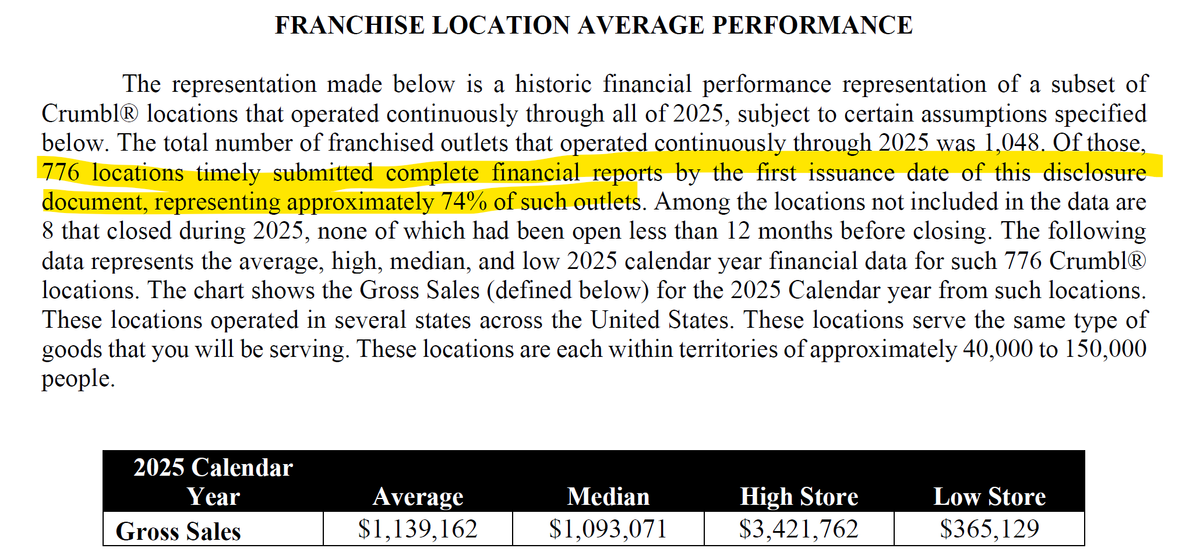
"Wait... why are only 74% of fully operational stores included in the Item 19 disclosed revenue figures?"
This immediately stands out when looking at Crumbl's Item 19 in their FDD.
To quote their disclosure:
'776 locations timely submitted complete financial reports by the first issuance date of this disclosure document' [out of 1,048 locations continuously operating in the year].
"But doesn't a franchisor have to submit their financial statements for audit and include those in the same disclosure document?"
Item 21 (and the related exhibits) are part of the ~300 pages in an FDD.
A franchisor receives revenue (from franchisees) in the form of royalties, advertising and marketing fees, and tech fees.
In the case of Crumbl, we see they made $99.1M in royalty fee revenue in FY 2025.
Crumbl charges an 8% royalty which is payable weekly. This calculates out to an estimated ~$1.24B in systemwide franchisee sales for FY 2025 ($99.1M royalty revenue / 8% royalty rate).
In order to receive royalties, the franchisor must track franchisee sales (which are the very basis for franchisor revenue).
"So the franchisee makes a sale. The franchisor collects 8% royalty on the sale. The franchisor reports revenue on the royalties. And the royalty revenue is audited and included in the FDD?"
Yes.
"And Item 21 has these audited franchisor financials with all royalty revenue included in the FDD?"
Yes.
"But Item 19 of the same FDD shows only 74% of stores were included in revenue disclosures?"
Yes.
"So how is it possible that Item 19 financial disclosures exclude 26% of fully operational stores but all stores were included in franchisor financials?"
A franchise is based on repeatable systems and playbooks.
74% on time financial reporting across > $1B in systemwide sales is a valid diligence question to raise.
It is also important to consider that Item 19 of an FDD is *not* a 10-K. There is not a specified set of required disclosures.
Revenue, which locations or affiliates are included, territory sizes, store sizes, franchisee longevity, job metrics... Item 19 disclosures can vary widely among brands.
This is also what makes it technically challenging to extract, normalize, and aggregate when doing any sort of comparison across brands.
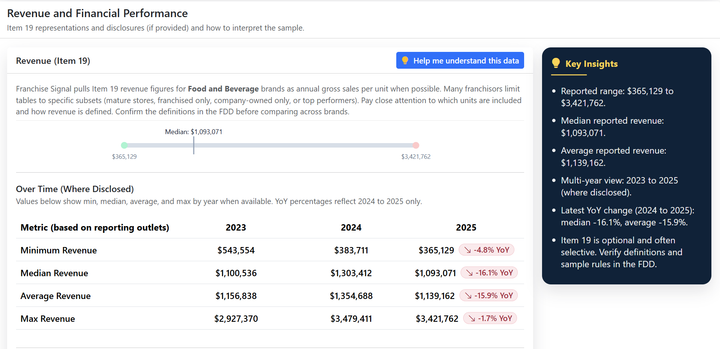
At Franchise Signal, we ingest thousands of FDDs to provide structured data, top down sector analytics, and YoY delta analysis for hundreds of brands.
All so that you can look at Item 19 figures normalized where available, reporting disclosures, and the full FDD for hundreds of brands.
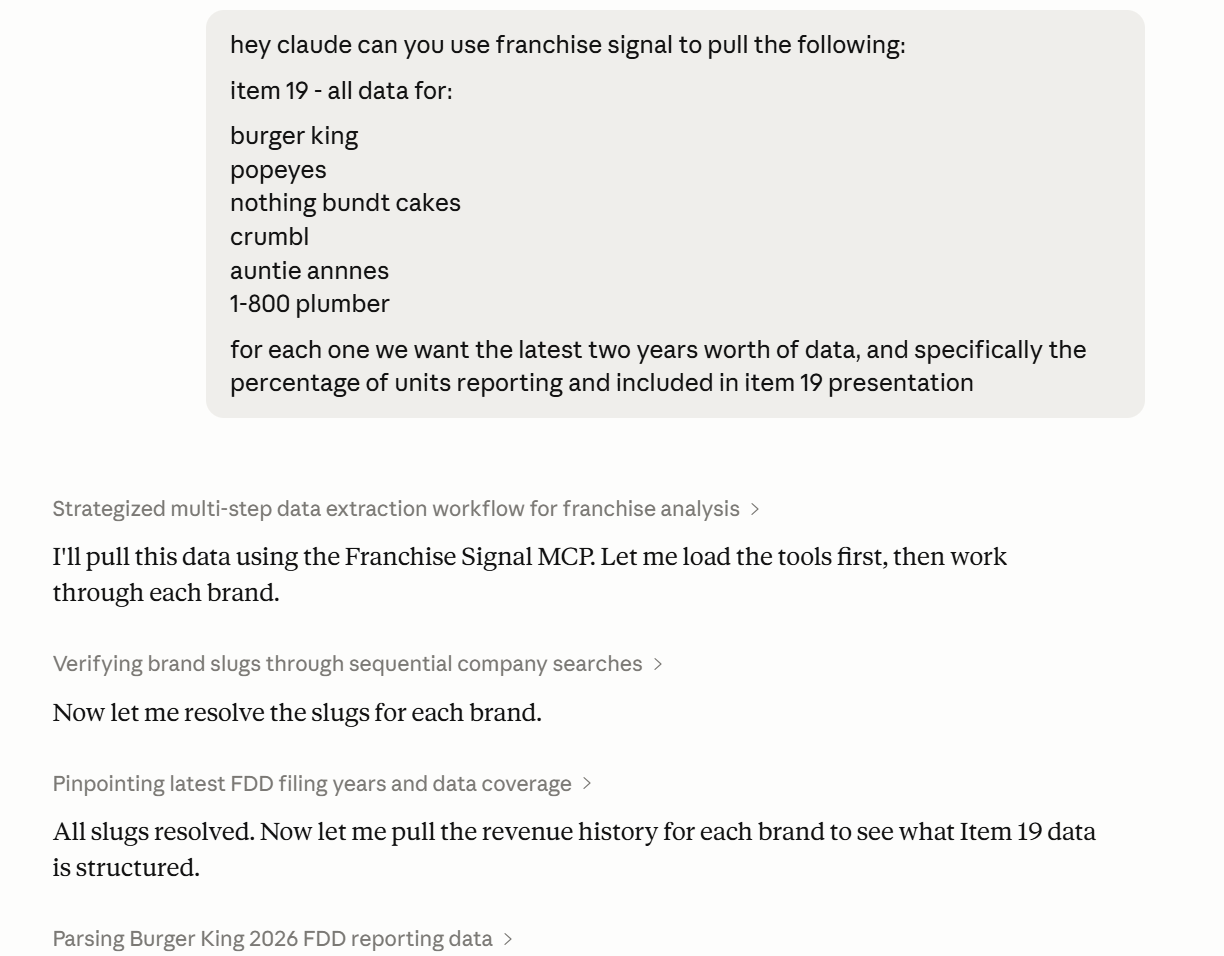
Create an account at Franchise Signal and ask diligence questions within your Claude workspace - all with the added FDD data (across multiple years) for your prospective brand(s). Download FDDs directly for additional research.
This article is Part 2 of a 5 part Series in a case study on Franchise Diligence. For the full company profile and summary please see this report.
To see Part 3, click here.
It is important to note that nothing on this site is investment or legal advice. This site does not constitute full diligence in any way. You should reference the FDD(s) of any brand you are looking at. Franchise Signal may make mistakes. If you are actively considering investing in a franchise you should consult with a franchise attorney.

Comments ()